
Affiliate Disclosure
We participate in Amazon affiliate program, earning fees from qualifying purchases via links at no extra cost to you.
An anxious cat doesn’t just need food on schedule — it needs a mechanism that doesn’t startle it, doesn’t trigger resource-guarding stress, and doesn’t add a new source of unpredictability to its day. That’s a different set of priorities than picking a feeder for a confident, food-motivated cat.
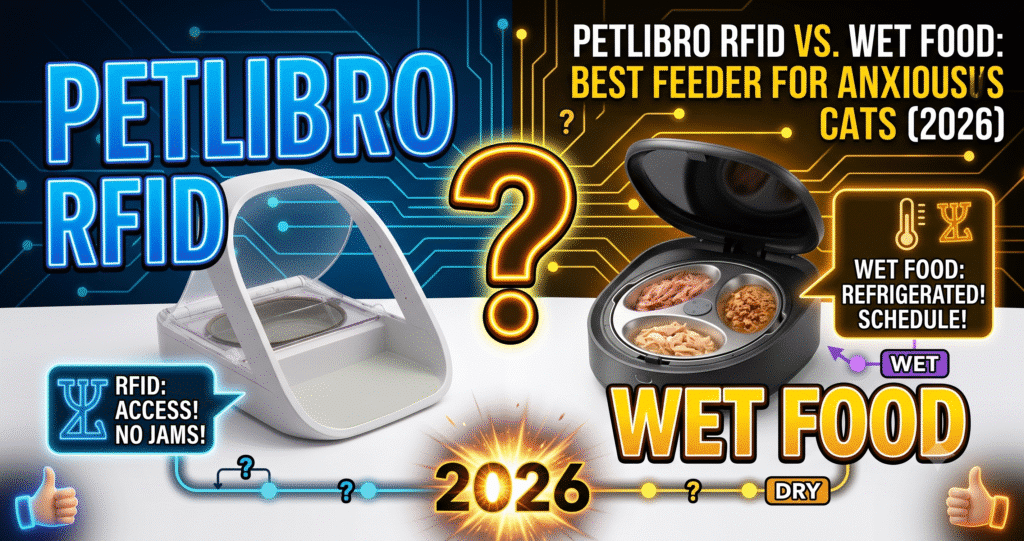
We compared PETLIBRO’s two most relevant models for this specific problem: the RFID collar-tag feeder and the refrigerated wet food feeder. Neither was designed explicitly “for anxious cats,” but their mechanical differences matter a lot once you look at them through that lens.
The Bottom Line: The RFID feeder is the better pick for most anxious cats — its adjustable lid-close speed and personalized access remove two common stress triggers the wet food feeder doesn’t address.
The Killer Feature: A lid-close speed you can slow down specifically for a nervous cat, so the mechanism never startles it mid-meal.
The 2026 Value Scores: RFID: 8.8/10 · Wet Food: 7.6/10 (both scored specifically for anxious-cat suitability, not general use)
Which PETLIBRO Feeder Has a Calmer Mechanism for Nervous Cats?
The RFID feeder wins here specifically because its lid-close speed is adjustable in the app — you can slow it down for a cat that startles easily, then speed it back up once the cat is confident. The wet food feeder doesn’t offer this control; its compartment mechanism runs on a fixed schedule.

Owners who switched from belt-style feeders single out how quiet the RFID unit’s door mechanism is — it glides open and shut with minimal noise, which matters for a cat that’s already on edge around unfamiliar sounds. Sudden mechanical noise at mealtime is a common, avoidable stressor, and this feeder’s design specifically minimizes it.
Does the Wet Food Feeder’s Anti-Pinch Design Help Anxious Cats?
Yes, in a different way — its infrared sensors detect a cat at the lid and automatically delay closing to prevent pinching, which removes a real physical scare that could otherwise make a nervous cat avoid the feeder entirely after one bad experience.

The tradeoff is that this feeder doesn’t offer the RFID model’s per-cat access control or adjustable approach speed, so it’s a better fit for a single anxious cat eating wet food than for a multi-cat household where resource competition is part of what’s driving the anxiety in the first place.
The Reality of Long-Term Ownership
Maintenance & wear: The RFID feeder’s feeding mat shows crumbs and hair quickly and needs regular wiping, which matters more for an anxious cat that may be put off by a visibly messy feeding area. The wet food feeder’s stainless tray is dishwasher-safe and easier to keep consistently clean, which supports the predictability an anxious cat benefits from.
Hidden costs: Neither feeder has a subscription fee. The RFID feeder needs one collar tag per cat beyond the single tag included, which adds cost in a multi-cat home; the wet food feeder has no per-cat hardware cost since it doesn’t use pet recognition.
The “Tinkerer’s Hack”: On the RFID feeder, pair the slowest lid-close setting with placing the unit somewhere your cat can approach from an open angle rather than a corner — nervous cats are more likely to commit to investigating a mechanism they don’t feel cornered near.
PETLIBRO RFID vs. Wet Food: Feature Comparison for Anxious Cats
Neither feeder was built specifically for anxiety, but their existing features map onto anxious-cat needs very differently once you compare them side by side.
| Feature | PETLIBRO RFID | PETLIBRO Wet Food | Winner | Why It Won |
|---|---|---|---|---|
| Price | $149.99 | $161.49 | RFID | Lower cost with more anxiety-relevant controls |
| Adjustable approach speed | Yes, app-controlled lid speed | No adjustable speed | RFID | Direct control over startle risk during the mechanism’s operation |
| Physical safety design | Standard lid mechanism | Infrared anti-pinch sensors | Wet Food | Actively prevents a scary pinch incident, not just slower motion |
| Multi-cat resource conflict | RFID-gated, personalized meals | Scheduled compartments only | RFID | Removes food-stealing stress that compounds anxiety in shared spaces |
| Operating noise | Quiet turnstile mechanism | Not specifically quiet-rated | RFID | Buyers specifically note near-silent operation |
| Food type flexibility | Dry food only | Wet food with active cooling | Wet Food | Only option if your cat’s diet requires wet food |
| Cleaning ease | Mat needs frequent wiping | Dishwasher-safe stainless tray | Wet Food | Easier to maintain a consistently clean feeding area |
Pros
- Both use stainless steel food-contact surfaces
- Both include app-based remote monitoring
- Both remove some form of mealtime unpredictability an anxious cat would otherwise face
Cons
- Neither is marketed or engineered specifically for anxiety — you’re adapting general features
- RFID feeder requires collar tolerance, which some anxious cats resist
- Wet food feeder offers no personalized access, a problem in multi-cat homes
Frequently Asked Questions
Will an automatic feeder make my anxious cat more stressed?
It can, if the mechanism is unpredictable or startles the cat. Features like adjustable lid speed and anti-pinch sensors specifically reduce that risk, which is why mechanism design matters more than general feature lists for anxious cats.
Is the RFID collar tag itself stressful for an anxious cat?
Some cats resist wearing any collar regardless of what it’s for, which is a real limitation of the RFID feeder. If your cat won’t tolerate a collar, the wet food feeder’s schedule-based approach avoids that issue entirely.
Which feeder is better for a multi-cat household with one anxious cat?
The RFID feeder, generally — personalized access prevents other cats from crowding or stealing food, which removes a major source of mealtime stress in shared spaces that the wet food feeder’s scheduled compartments don’t address.
How long does it take an anxious cat to adjust to an automatic feeder?
It varies by cat, but starting with the slowest lid-close speed and placing the feeder somewhere the cat doesn’t feel cornered both shorten the adjustment period based on buyer feedback on the RFID model.
Can I use the wet food feeder for a cat that eats both wet and dry food?
Yes, but it’s built around refrigerated wet-food compartments specifically — if most of your cat’s diet is dry kibble, the RFID feeder’s dry-food dispensing and personalized access are the better overall fit.
Should I get both feeders for one anxious cat?
Only if your cat genuinely eats both wet and dry meals on a schedule. Running two unfamiliar mechanisms at once during an adjustment period can add complexity rather than reduce stress — introduce one at a time if possible.
Related Reading on PawSavvyTech
More context if you’re weighing these feeders against other options:
- Best Automatic Cat Feeders for Working Pet Parents (2026) — how these two stack up against a third option, the SureFlap SureFeed
- 7 Things to Check Before Buying an Automatic Pet Feeder — the mechanical checklist behind this comparison
- Gravity vs. Timed vs. Portion-Control Feeders — if neither RFID nor wet food access matters for your cat
Related posts:
 Best Automatic Cat Feeders for Working Pet Parents (2026)
 7 Things to Check Before Buying an Automatic Pet Feeder (2026)
 Top 10 Luxury Pet Tech Gadgets of 2025: Pampering Pets in the USA and Beyond
 16 Best Smart Pet Cameras for Your Home
 Smart Pet Feeders for 2025: The Ultimate Guide to High-Tech Nutrition for Picky Eaters
 Best Dog Car Seats for 2025: Top Picks for Safety and Comfort
 Top 10 Automatic Cat Water Feeders for 2025
 Top 10 Best Puppy Playpens for Small and Large Puppies in 2025
 Bird Buddy PRO Solar Smart Bird Feeder Review: A Must-Have for Bird Lovers
 Pet Tech Subscription Cost: The True 5-Year Price of GPS Trackers & Smart Feeders
 Tired of Pet Hair? Teendow D20S Max+ Review: The 6000Pa Robot That Saves Pet Parents 70 Days of Cleaning!
 PuroAir HEPA Air Purifiers for Pet Owners: Eliminate 99.9% Pet Dander 2026
